Container Drainage: Holes, Saucers and Where the Water Goes
How to keep balcony pots draining well: holes in the base, why a gravel layer does not help, pot feet, saucers you empty, and how to keep runoff away from the neighbors below.
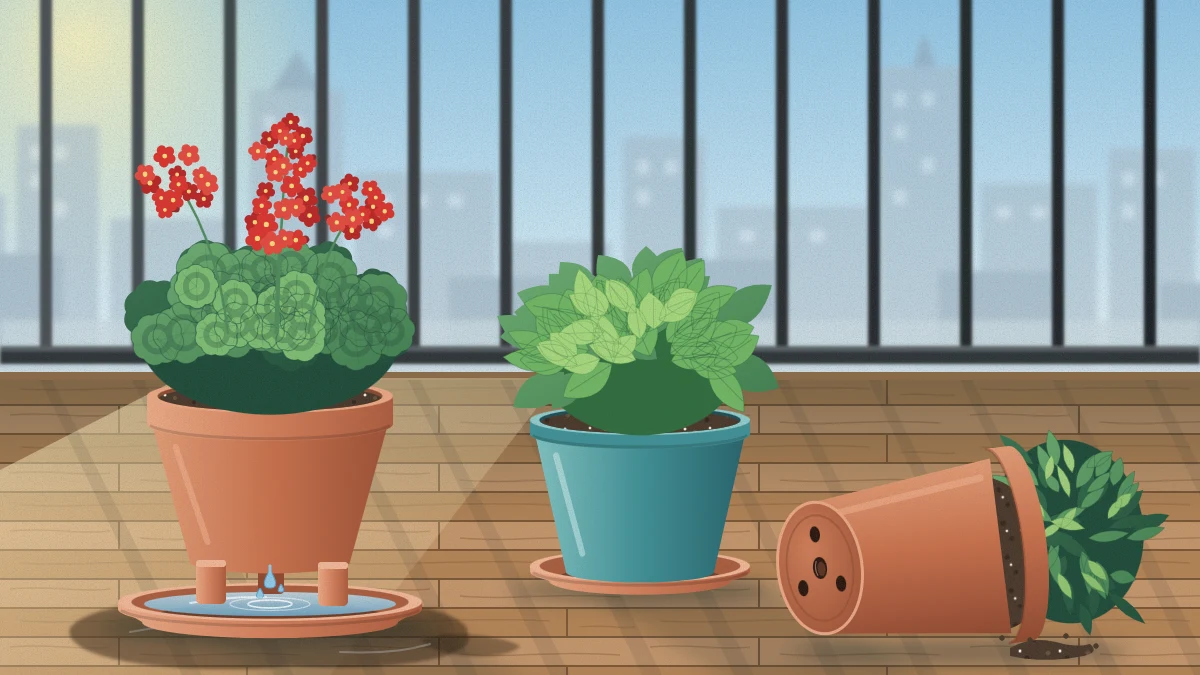
Water goes in at the top of a pot and has to come out at the bottom. On a balcony that second half matters twice: once for the roots, and once for whoever lives underneath you. Good container drainage is the set of small habits that keeps both of them happy.
None of it is complicated or expensive. You need holes in the base of every pot, a way to keep those holes open, something to catch the runoff, and a clear idea of where the water ends up once it leaves the saucer.
Why roots need water to leave
Potting mix is full of small gaps. When you water, those gaps fill up. As the extra water drains out through the bottom, fresh air is pulled back into the mix behind it. Roots need that air as much as they need moisture.
If the water has no way out, the gaps stay flooded. Roots that sit in airless, soggy mix stop working well and may begin to rot. Confusingly, a plant in that state often wilts or turns yellow, which can look like thirst. Those symptoms have several possible causes, so feel the mix before you reach for the watering can. The guide to checking when a pot really needs water explains how.
Every container needs holes in the bottom
Turn a pot over before you buy it. You are looking for one or more drainage holes in the base, not just a molded dimple where a hole could be. Several small holes usually drain more evenly than a single large one, and holes placed at the lowest point of the base matter most, because that is where water collects.
Drainage is the first thing to check when you are choosing balcony planters, ahead of color, shape or material.
Adding holes to a plastic container
Many plastic and resin pots are sold with the holes marked but not opened. You can drill drainage holes in the base of a plastic pot with an ordinary drill bit: turn the pot upside down on a scrap board, work slowly, and make several holes spread across the bottom.
Ceramic and terracotta crack easily, so most beginners are better off leaving them alone and using them as a sleeve instead.
Decorative pots without holes
A handsome pot with a solid base still has a job. Grow the plant in a plain inner pot that drains, and set that inside the decorative one as an outer sleeve. After watering, lift the inner pot out and pour away whatever has gathered at the bottom, or the roots will end up standing in a hidden pool.
Skip the gravel layer
A layer of gravel, pebbles or broken pot pieces under the mix is one of the most repeated bits of pot advice, and it does not do what people hope. Water does not move readily from fine potting mix into a coarse layer below it. It tends to stay in the mix until the mix is saturated, so the wettest zone simply sits higher in the pot, closer to the roots.
The layer also takes up room that roots could use, which matters in the modest pots most balconies have space for. University of Maryland Extension states plainly that rocks, gravel or broken shards in the bottom of a container will not improve drainage.
Fill the whole container with a good mix instead. What helps water pass through is the texture of the mix itself, which is covered in the guide to potting soil for containers.
Tip
If a large hole lets potting mix wash out, cover it with a small square of plastic mesh, a piece of window screen or a paper coffee filter. Water still passes through, and the mix stays in the pot.
Pot feet and risers keep the holes open
A flat-bottomed pot sitting flat on a balcony floor can seal its own drainage holes. Water backs up inside, and the patch of floor underneath stays damp and stained.
Pot feet are small wedges or blocks that lift the base about an inch (2.5 cm). Three or four under each pot are enough. Slatted plant stands and low risers do the same job. With a gap underneath, water runs out freely, the floor dries between waterings, and you can see at a glance whether a pot is draining at all.
Saucers: catch the runoff, then empty it
A saucer under each pot protects your floor and keeps muddy water from running toward the edge. Choose one a little wider than the base of the pot, and deep enough to hold a real pour of runoff rather than a few drops.
The catch is that a full saucer turns back into the problem you were avoiding. A pot left standing in water for long draws it up again and stays soggy at the bottom. So treat the saucer as a temporary catch basin:
- Water, then give the pot a few minutes to finish dripping.
- Tip the saucer out into a bucket or onto a plant that needs it.
- For pots too awkward to lift, soak the water up with an old sponge or towel.
- After heavy rain, check the saucers again, since rain fills them just as watering does.
Where the water goes on a balcony
Look at your balcony floor the next time it rains. Most balconies slope slightly toward a floor drain or toward a scupper, which is an opening at the edge that lets water run off. Find yours before you arrange any pots, and keep it uncovered.
Drains clog easily with fallen leaves, petals and spilled potting mix. Sweep rather than hose loose mix away, and lift debris off the drain cover whenever you tidy up. A blocked drain can leave water pooling against the door or the wall.
Then think about the people below. Never let water pour over the edge onto a balcony, window or path underneath, because dirty runoff landing on a neighbor’s laundry or chair is a fast way to sour a relationship, and some buildings have rules about it.
- Water slowly, at the surface of the mix, so the runoff is a trickle the saucer can hold.
- Stop as soon as water appears at the holes.
- Keep pots back from the edge of the floor so stray drips land on your own balcony.
- Wipe up puddles instead of sweeping them toward the edge.
Check your pots now and then through the season. Roots grow, mix settles, and a pot that drained well in spring can be slower by late summer.
Frequently asked questions
Can I grow plants in a pot with no drainage holes?
It is much harder, because extra water has nowhere to go and the mix at the bottom stays saturated. The easier route is to keep the plant in a plain inner pot that drains and use the solid pot as a decorative sleeve, pouring away any water that collects inside after you water.
Should I put rocks in the bottom of a planter?
No. A layer of rocks or gravel does not help water leave the potting mix, and it takes space that roots could use. Fill the container with potting mix all the way down, and cover a large hole with mesh or a coffee filter if you need to stop mix from washing out.
How do I stop water from dripping onto the balcony below?
Use a saucer under every pot, water slowly so the runoff stays a trickle, and stop when water first appears at the holes. Keep pots back from the edge of the floor, empty saucers after watering, and wipe up puddles rather than sweeping them off the balcony.