Watering Balcony Plants: How to Tell When Pots Need Water
Learn how to check whether a pot needs water, how to water so the whole root ball gets wet, and how to read the signs of too much and too little.
At a glance
What you need
- Watering can with a long spout
- Saucers for each pot
- Bucket or tub for soaking dry pots
- Mulch such as fine bark or gravel
Most container plants that struggle on a balcony are not short of attention. They are watered by the calendar instead of by need, and a pot has no idea what day it is. Watering balcony plants well comes down to one habit: check the potting mix first, then decide.
That check takes a few seconds per pot and removes most of the guesswork. Below you will find how to check, how to water so the whole root ball gets wet, and how to read the signs when something is off.
Why no fixed schedule works
How fast a pot dries depends on several things at once, and they change from week to week:
- The plant. A large, leafy tomato in fruit uses far more water than a small lavender or a succulent.
- The container. Small pots dry faster than large ones. Unglazed terracotta loses moisture through its walls, while plastic and glazed ceramic hold it longer.
- The potting mix. A coarse, fast-draining mix dries sooner than a dense one, and old mix that has broken down behaves differently from fresh.
- Sun, heat and wind. Direct sun and hot walls pull water out quickly, and wind can dry a pot even on a cool day.
- The season. Growth, day length and temperature all shift what a plant needs.
As an example of the range, the same pot may need water twice during one hot, windy day and then stay moist for a week in cool, cloudy weather.
How to check whether a pot needs water
Use these two checks together until you get a feel for your own pots.
- The finger check. Push a finger about 2 in (5 cm) into the potting mix, away from the stem. If it feels dry at that depth, most plants are ready for water. If it feels cool and damp, wait and check again later.
- The lift check. Lift the pot slightly, or tilt it if it is too large to lift comfortably. A freshly watered pot feels noticeably heavier than a dry one.
Plants that prefer to dry out between waterings, such as succulents and many Mediterranean herbs, can wait until the mix is dry deeper down. Thirsty plants in full growth usually want water as soon as that top layer is dry.
Tip
Wilting in the afternoon heat is not always thirst. Some plants droop in strong sun and recover by evening even when the mix is moist. Check the mix before you reach for the can, because adding water to a pot that is already wet can make things worse.
How to water a container properly
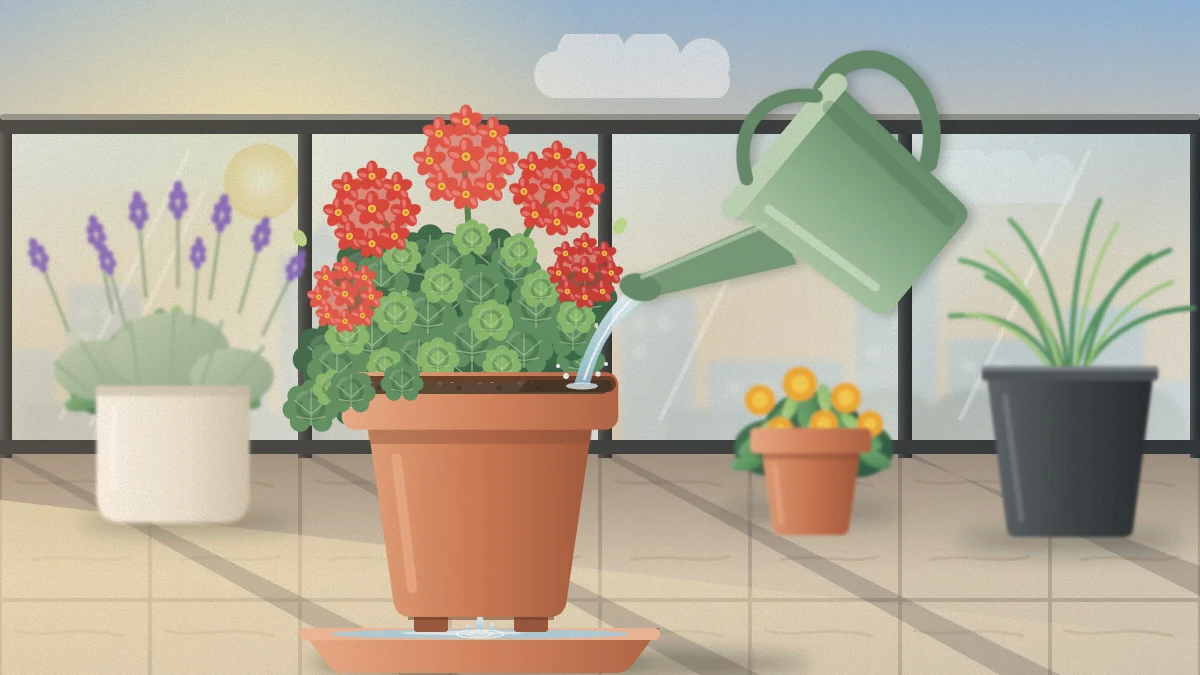
- Aim the spout at the surface of the mix, under the leaves, rather than pouring over the plant. Wet foliage does little for the roots and can encourage leaf diseases.
- Pour slowly and move around the pot so the whole surface is wetted, not one spot.
- Keep going until water begins to run from the drainage holes, then stop. That is the signal that water has reached the bottom of the root ball.
- If the mix was very dry and the water ran straight through within seconds, wait a few minutes and make a second slow pass. Dry mix often lets the first pour slip down the sides without soaking in.
- After about half an hour, empty any saucer that still holds water so the pot is not left standing in it.
All of this relies on water being able to leave the pot, so if yours stays soggy, read about how container drainage works before changing anything else.
The best time of day
Morning is usually the best time. The plant goes into the warmest part of the day with a full supply, and any splashed leaves dry quickly. Evening is a good second choice, especially after a hot day, although foliage stays damp longer overnight.
If a plant is badly wilted and the mix is dry at midday, water it then. Waiting for the ideal hour helps nobody.
When very dry mix repels water
Potting mix that has dried out completely can shrink and shed water like a dry sponge. You pour, the water races down the gap at the pot wall, and the root ball stays dry.
For a pot you can carry, set it in a tub or bucket with a few inches of water and leave it until the surface of the mix feels damp, often somewhere between a quarter of an hour and an hour. Then lift it out and let it drain fully. For a pot that cannot be moved, water in several small, slow passes a few minutes apart, and gently press the mix back against the pot wall.
Reading the signs: too much or too little
These signs are associated with watering problems, but they overlap with each other and with other causes such as heat, cold, pests or a lack of nutrients. Use them as a prompt to check the mix, not as a verdict.
| What you see | Often associated with | What to check |
|---|---|---|
| Yellowing lower leaves, limp plant, mix still wet | Too much water or poor drainage | Drainage holes, saucer, how wet the mix is deeper down |
| Small dark flies hovering around the pot | Mix that stays wet (fungus gnats) | Whether the surface ever dries |
| Crisp brown leaf edges, dry fallen leaves | Too little water, or heat and wind | Mix at finger depth, exposure of the spot |
| Mix shrunk away from the pot wall | Mix that has dried out fully | Whether water is running down the gap |
Carrying water and keeping runoff contained
Choose a watering can that you can carry comfortably when it is full, with a long spout that reaches the back row of pots.
Water draining from your pots should not end up on the balcony below. Use saucers, water slowly so they do not overflow, and tip the saucers into a bucket rather than onto the floor. Check your building’s rules if you are unsure what is expected.
Slowing down drying
A layer of mulch on the surface of the mix, such as fine bark or gravel, shades it and slows evaporation. Larger pots hold more water than small ones, and grouping pots together reduces the wind reaching each one.
If you travel often or your balcony is very exposed, self-watering planters with a reservoir can stretch the time between refills, though they still need checking. During the hottest weeks, the extra steps in the guide to a balcony garden in summer will help. For more background, see the notes on watering from University of Illinois Extension.
Frequently asked questions
How often should I water plants on a balcony?
There is no single answer, because drying speed depends on the plant, the container, the potting mix, sun, heat, wind and the season. Instead of counting days, push a finger about 2 inches into the mix and water when it feels dry at that depth. In hot, windy weather that may be surprisingly soon.
Is it better to water potted plants in the morning or the evening?
Morning is usually best, because the plant starts the warm part of the day with a full supply and any wet leaves dry quickly. Evening is a reasonable second choice. If a plant is badly wilted and the mix is dry in the middle of the day, water it right away rather than waiting.
Why does water run straight through my pot?
Potting mix that has dried out completely often shrinks away from the pot wall and sheds water, so it runs down the gap and out of the drainage holes. Water in several slow passes a few minutes apart, or stand a movable pot in a tub of water until the surface feels damp, then let it drain.