Balcony Planters: How to Choose Containers That Fit Your Space
How to choose balcony planters by drainage, size, material and shape, with a comparison table of terracotta, ceramic, plastic, fabric, wood and metal containers.

The container aisle offers every shape, color and material, and almost none of the labels tell you what matters on a balcony. Choosing balcony planters comes down to four questions: does it drain, is it big enough, what is it made of, and will it stay where you put it?
Answer those in order and the choice narrows quickly. Looks can come last, because a handsome pot that dries out by noon or tips in a breeze will not look good for long.
Drainage holes come first
Turn every container over before anything else. It needs holes in the base so extra water can leave. Without them, water collects at the bottom, roots sit wet and plants commonly decline.
If you fall for a pot with no holes, use it as a decorative outer cover and set a plain pot with holes inside it, emptying any water that gathers. The full picture, including what not to put in the bottom of a pot, is in the guide to container drainage.
Size: bigger is easier
A larger volume of potting mix holds water longer and stays cooler in sun, so the plant has a steadier supply between waterings. Small pots dry fast and swing between soaked and parched, which is hard on roots and on you.
Match the pot to the mature plant, not the seedling. The plant label usually gives a mature height and spread, and those are a better guide than how the plant looks in the store.
- Small herbs and compact annuals: a pot about 8 to 10 in (20 to 25 cm) across suits one plant.
- Mixed flowers or several herbs: a pot about 12 to 16 in (30 to 40 cm) across, or a trough.
- Large fruiting vegetables such as tomatoes: a container of about 5 gallons (19 L) or more for each plant.
Treat these as rough starting points. For more on sizes for edible crops, see University of Maryland Extension. Whatever you choose, fill it with a proper mix for pots; the guide to potting soil for containers explains why soil from the ground is a poor choice.
Materials compared
Material decides how heavy a planter is, how quickly it dries and how it copes with weather. None is best for every balcony.
| Material | Weight | How fast it dries | Good to know |
|---|---|---|---|
| Terracotta | Heavy | Quickly; the clay is porous | Can crack in frost; suits plants that like to dry between waterings |
| Glazed ceramic | Heavy | Slowly; holds moisture | Check for drainage holes; may also crack in hard frost |
| Plastic and resin | Light | Slowly; holds moisture | Easy to carry; can blow over when the mix is dry |
| Fabric grow bags | Light | Quickly; drain freely | Need a tray beneath; fold flat for storage |
| Wood | Moderate | Moderately | Insulates roots from heat and cold; wears with time |
| Metal | Light to moderate | Varies | Heats up in direct sun; better in part shade |
Tip
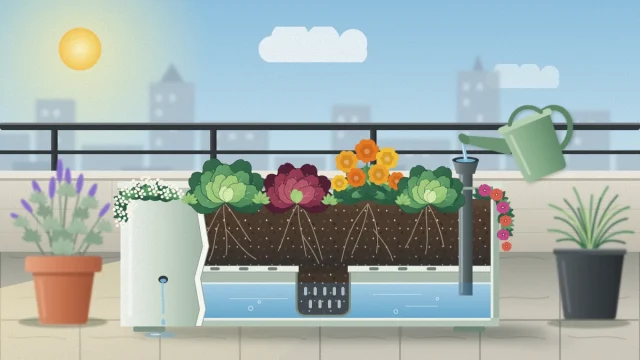
If you are often away, a planter with a built-in water reservoir can stretch the time between waterings. See how they work in the guide to self-watering planters.
Shape and stability
Wide, low pots are more stable in wind than tall, narrow ones. A broad base keeps the center of the container close to the floor, and a pot that is wider at the top than at the base is the easiest to topple once a tall plant fills it.
Shape also decides how well you use the floor:
- Rectangular troughs sit flush along the inner side of the railing or against the wall and use the edge of a narrow balcony well.
- Square pots fit into corners and group without gaps.
- Round pots are the most common and look good in clusters of different sizes, but waste a little space between them.
- Tall, slim planters take little floor but need a sheltered spot and a plant that will not make them top-heavy.
Weight cuts both ways
A heavy pot stays put in wind, which is an advantage. It is also harder to move, and it adds to the load on the balcony. Remember that the container is only part of it: wet potting mix, water and a mature plant weigh far more than the empty pot.
You cannot tell from looking what a balcony is built to carry, and it varies from building to building. Before bringing in large containers, or a number of medium ones, ask the building management or owner what the balcony is allowed to carry. Spreading pots out, instead of clustering all the largest ones in one spot, and placing them close to the building wall are sensible habits, but they do not replace asking.
Good to know
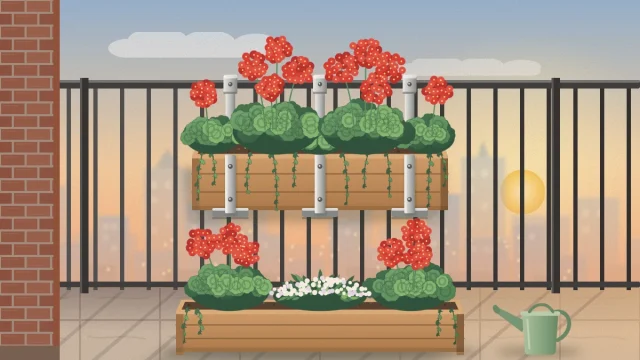
Containers on the floor, low, stable and inside the railing, are the simplest safe default. For heavy planters and for anything that hangs or attaches, such as hanging baskets or boxes on the rail: use secure mounting made for the purpose; check the building rules or lease, or ask the landlord or building management, before attaching anything; consider the weight of wet mix, water and the container; and follow the manufacturer instructions for the planter and its hardware.
Planters designed for the rail have their own fitting and sizing questions, covered in the guide to railing planters.
Saucers and pot feet
A saucer under each pot catches runoff, keeps the floor clean and stops water from dripping onto the balcony below. Choose one a little wider than the base of the pot. Empty saucers that are still full a while after watering, since most plants dislike standing in water for long.
Pot feet are small supports that lift a container slightly off the floor or the saucer. The gap lets water run out of the drainage holes freely and helps the floor beneath dry, which reduces staining. Use feet that sit flat and steady, and skip them on tall pots in windy spots if they make the container rock.
A quick checklist before you buy
- Does it have drainage holes, or can it hold a pot that does?
- Is it large enough for the mature plant?
- Does the material suit your sun, wind and winter?
- Is the shape stable, and does its footprint fit your plan?
- Can you lift it when it is full and wet, and has the building confirmed what the balcony may carry?
- Is there a saucer that fits?
A few generous, sturdy containers nearly always serve a balcony better than many small ones. They are steadier, easier to keep watered and kinder to the plants in them.
Frequently asked questions
What is the best material for balcony planters?
It depends on the balcony. Plastic and resin are light and hold moisture but can blow over when dry. Terracotta is steady but dries quickly and can crack in frost. Wood insulates roots, and metal heats up in sun. Match the material to your sun, wind and winter.
Are large planters better than small ones on a balcony?
For the plants, usually yes. More potting mix holds water longer and protects roots from heat. Large containers are also heavier when wet, so ask the building management or owner what the balcony is allowed to carry before bringing them in.
Do balcony planters need saucers?
Yes, in most cases. A saucer catches the water that runs from the drainage holes, keeps the floor clean and stops drips from reaching the balcony below. Empty any saucer that is still full a while after watering so roots do not stand in water.