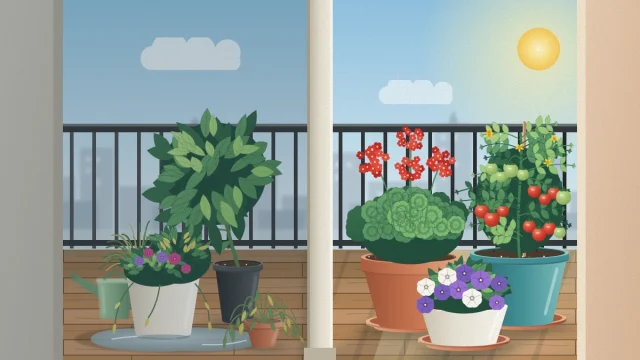
Windy Balcony Garden: How to Assess and Handle Wind Exposure
Learn how to read the wind on your balcony with a simple ribbon test, then protect plants with low, stable containers, smart placement, wind-tolerant plants and storm preparation.
Leaves shredded at the edges, a tall plant lying on its side again, potting mix that is dry by the afternoon: these are common complaints on upper floors and exposed corners. A windy balcony garden asks for different choices than a sheltered patio, but it does not ask for much equipment.
Most of the answer lies in where you put things and what shape they are. Start by learning how the wind moves across your balcony, then work through the responses below from the simplest to the more involved.
What wind does to container plants
Wind causes four kinds of trouble, and it helps to know which one you are dealing with.
- It dries everything. Moving air pulls moisture from leaves and from the surface of the potting mix. A pot in a breezy spot can dry far faster than the same pot in a still corner.
- It tears leaves. Large, soft leaves act like sails. They rip, brown at the edges and look ragged.
- It snaps stems. Tall, top-heavy plants with brittle stems break at the base or where a branch joins.
- It moves containers. Light pots slide, tall ones tip, and empty saucers or tools can be carried off.
Wilting on a windy day does not always mean the pot is dry. Leaves can lose water faster than the roots supply it even in moist mix, so check with a finger about 2 in (5 cm) down before adding more. The guide to watering balcony plants covers how wind changes the checks.
How to assess the wind on your balcony
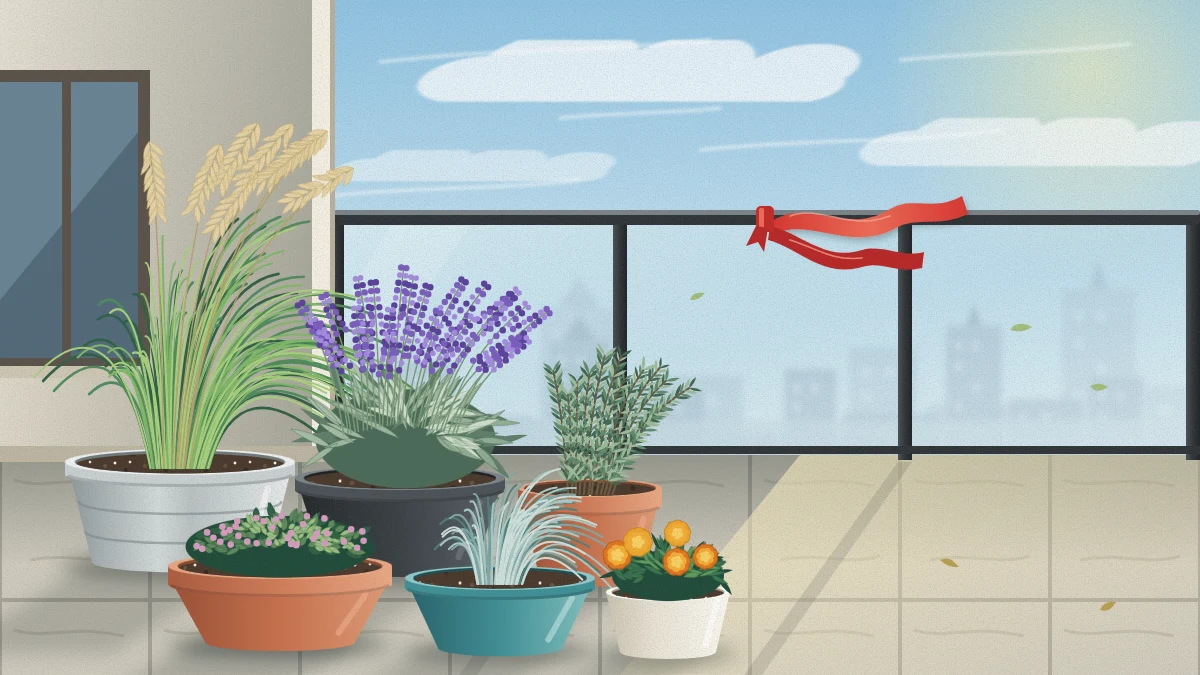
You do not need instruments. Tie a ribbon or a strip of light fabric to the railing on the balcony side and watch it over several days.
- Look at the ribbon morning, afternoon and evening, and note how often it streams out straight.
- Notice the direction. Wind along a building often comes from the same side most days.
- Stand in each corner on a breezy day. Some corners are calm while others funnel the wind between walls and speed it up.
- Check at floor level as well as at railing height. A solid balustrade shelters the floor; open bars let wind through.
Higher floors and corner units are usually windier. Wind also changes with the season, so repeat the check in spring and fall.
Start with the containers
The simplest response is also the most effective: keep containers low, wide, heavy-bottomed and on the floor. A wide base and a low center are much harder to push over than a tall, narrow pot.
Light plastic pots are the first to go over, especially when the mix has dried out. The guide to choosing balcony planters compares materials and shapes.
Weight cuts both ways. A heavy pot stays put, but wet mix, water and the container all add to what the balcony carries. Ask the building management or owner what the balcony is allowed to carry before bringing in large containers.
Use placement as shelter
Where pots stand matters as much as what they are.
- Group pots tightly. A cluster shelters itself. Put the toughest, lowest plants on the windward side and more delicate ones behind them.
- Put tall plants against the wall. The wall breaks the wind and catches a plant that leans.
- Use the calm corner. Your ribbon check will show one. Save it for anything with large leaves or fragile stems.
- Keep the top of the railing clear. Never rest a loose pot on a ledge or railing cap, where a gust could push it off.
Choose plants that cope with wind
Plants that do well in exposed places tend to share a few traits: they are compact, their stems bend instead of breaking, and their leaves are small, narrow or leathery.
- Many herbs: thyme, rosemary, sage, oregano and lavender have small, firm leaves and low growth.
- Ornamental grasses: they flex in the wind and look good doing it.
- Compact annuals: low, mounding flowers hold together better than tall or large-flowered kinds.
- Succulents with fleshy leaves: low growers such as sedum sit close to the pot.
Be cautious with tall, large-leaved or brittle plants, and give them your most sheltered spot.
Stake tall plants inside their own pot
A stake helps a tall plant only if the stake is steady. Push it deep into the potting mix near the edge of the pot, away from the main roots, and tie the stem loosely with soft ties in a figure eight so it can move a little without rubbing.
Keep the support inside the plant’s own container. Tying a plant to the railing does not hold the pot, and a stake does not make a narrow pot stable. If the whole container rocks, the fix is a wider container or a better position.
Screens and windbreaks
A screen can calm a balcony noticeably, but it is the last step, not the first. A screen catches wind like a sail, and the force goes into whatever it is fixed to.
Add one only if the building allows it, and fix it exactly as its maker instructs. If a screen is not permitted, a row of tough plants in low, sturdy troughs along the windward side gives some of the same shelter.
Good to know
Wind makes every attachment matter more. For railing planters, hanging baskets, screens or anything else fixed to the building, use secure mounting made for the purpose, check the building rules or lease (or ask the landlord or building management) before attaching anything, consider the weight of wet mix, water and the container, and follow the manufacturer instructions for the planter and its hardware. Keep planters on the inner side of the railing, and never hang anything over the street or a balcony below.
On a very exposed balcony, the floor is often the better choice for everything. If you still want boxes on the rail, read the guide to fitting railing planters first.
Before a storm
Nothing should be able to fall or blow from your balcony. When strong wind is forecast, take a few minutes to prepare.
- Bring light pots, hanging items, empty saucers, tools and cushions indoors.
- Move remaining containers down to the floor and against the wall, grouped together.
- Lay tall plants on their side in a sheltered corner if they cannot come inside.
- Fold or take down furniture, umbrellas and removable screens.
For general advice on preparing for high wind, see the National Weather Service wind safety pages. Afterward, stand the plants back up, trim broken stems cleanly and check the mix before watering.
Frequently asked questions
How can I tell if a balcony is too windy for plants?
Tie a ribbon to the railing and watch it for several days. If it streams straight out most of the time, treat the balcony as exposed. Few balconies are too windy for any plants at all, but an exposed one calls for low, sturdy containers and compact, flexible, small-leaved plants.
Why do plants wilt on a windy day when the potting mix is moist?
Wind can pull water from leaves faster than roots replace it, so a plant may droop even in moist mix. It is one possibility among several. Check the mix with a finger before watering, and see whether the plant recovers in the evening when the wind drops.
What should I do with balcony plants before a storm?
Bring anything light or hanging indoors, along with saucers, tools and cushions. Move the remaining containers to the floor against the wall and group them. Tall plants can be laid on their side in a sheltered corner. Nothing should be left where a gust could carry it off the balcony.