Railing Planters: What to Check Before You Install One
The checks to make before putting any planter on a balcony railing: the building rules, the railing itself, the product, the weight when wet and the position, plus floor options that give the same look.
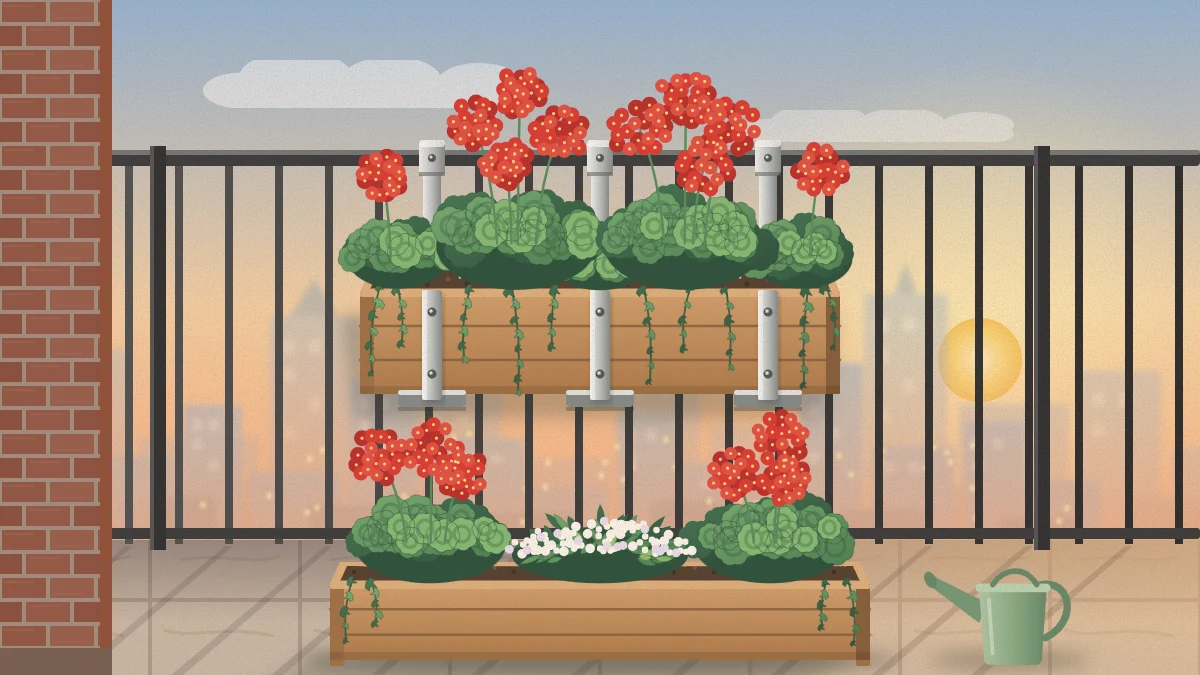
A row of flowers along the top of a balcony rail looks wonderful and takes up no floor space at all. It is also the one part of a balcony garden that can fall on someone. Railing planters deserve more thought than any other container you will buy.
The checks below come in a deliberate order: the rules, the railing, the product, the weight, and then the position. If any one of them gives you an unclear answer, the floor is always available.
Check the rules first
Many apartment buildings, leases and owners’ associations restrict or completely ban anything attached to, resting on or hung from a balcony railing.
Read your lease or the building rules, and if they do not mention planters, ask the landlord or building management in writing before you buy anything. Keep the reply.
If the answer is no, that is the end of the question for this balcony. A neighbor who already has boxes on a rail is not permission.
Look hard at the railing
A balcony railing is a guard. Its purpose is to stop people from falling, and it is not automatically meant to carry extra load on top of or beside it. You cannot judge what a railing may carry by pushing on it, by how thick the metal looks, or by its age.
So do not guess. The building management or owner is the right source for whether anything may be mounted on the railing at all, and they may need to ask whoever maintains the building. If nobody can tell you, treat that as a no.
The railing’s shape also decides which planter systems can fit in the first place:
- Top rail width and profile. Flat, round and wide rails each need a different holder, and many holders adjust only within a narrow range.
- What is below the rail. Glass and thin infill panels are not something to clamp or lean a planter on.
- Condition. Rust, loose posts, wobble or cracked fixings are a reason to report the railing to the building, and a reason to keep everything off it.
Buy only a system made for railings
Use a planter and holder that the manufacturer designed and sells for balcony railings, in the size that matches your rail. A window box, an ordinary trough or a pot balanced on the rail is not a substitute, and neither is a holder bent or padded to fit a rail it was not made for.
Zip ties, wire, string and elastic cords are not mounting hardware. They degrade in sun and weather, and they should never be what holds a planter in place.
Then follow the manufacturer instructions exactly: which rail shapes and widths the system fits, how each fixing is fitted and tightened, how it sits on the rail, and how full the planter may be if a maximum fill is given.
If the instructions are missing, unclear or do not cover your type of rail, do not improvise. Choose a different product or a floor planter.
For spacing and filling, see the guide to planting a balcony flower box.
Think about the weight when it is wet
An empty planter in a shop feels like almost nothing. Wet potting mix, the water held in it and a season’s growth of plants together weigh far more than the empty container, and the difference is larger than most people expect.
No article can give you a figure, because it depends on your building, your railing and your hardware. Keep the total as low as possible:
- Choose a smaller, shallower planter rather than the longest and deepest one available.
- Use a light potting mix, never garden soil.
- Pick compact plants that stay small, not ones that will grow tall and catch the wind.
- Stay within any fill limit the maker gives, and do not let a blocked planter fill with rainwater.
Good to know
Four checks apply every time: use secure mounting made for the purpose; check the building rules or your lease, or ask the landlord or building management, before attaching anything; consider the weight of wet mix, water and the container; and follow the manufacturer instructions for the planter and its hardware. If you cannot satisfy all four, keep the planter on the floor.
Keep it on the balcony side
Where the planter sits in relation to the rail changes what happens if something comes loose. The better position is on the inner, balcony side of the railing, so that a planter, a pot or a lump of wet mix that slips lands on your own floor.
Never hang planters on the outside of the railing over a street, a path, a parking area or a balcony below, even where a product is sold for that position. People walk and sit under balconies, and you cannot see them from above.
Water follows the same logic. Water slowly, and place the planter so that drips fall onto your own floor and not onto a neighbor.
Inspect it, and take it down before storms
Weather, vibration and the weight of growing plants all work on fixings over time.
- Check every fixing by hand at regular intervals through the season and after any strong wind.
- Look for cracks in plastic, rust on metal, slipped holders and a planter that no longer sits level.
- Take the planter down at once if anything has moved, and do not put it back until you know why.
- Before a storm or a forecast of high wind, lift railing planters down and set them on the floor against the wall.
Wind is stronger on upper floors and at corners than it feels at street level. The guide to a windy balcony garden explains how to judge your exposure, and the National Weather Service has general advice on preparing for high wind.
The same checks apply to anything suspended, which is covered in the guide to hanging baskets on a balcony.
Floor alternatives that give the same look
If the rules say no, the railing is in doubt, or you would simply sleep better, you can still have flowers at the edge of the balcony.
- A trough on the floor against the railing. A long rectangular planter at the foot of the rail puts flowers along the same line, and upright plants soon rise toward rail height.
- A freestanding plant stand. A low, wide, stable stand set inside the railing raises pots toward eye level without touching the rail. Keep the largest pots on the lowest level.
Low, stable containers on the floor, inside the railing, are the simplest arrangement to live with.
Frequently asked questions
Are railing planters allowed on apartment balconies?
It depends entirely on the building. Many leases and association rules restrict or ban anything attached to or hung from a railing. Read your lease or building rules, and if they are silent, ask the landlord or building management in writing before you buy a planter.
How do I know whether my railing can take a planter?
You cannot tell by looking at it or pushing on it. A railing is a guard and is not automatically meant to carry extra load. Ask the building management or owner whether anything may be mounted on it. If nobody can give you a clear answer, keep your planters on the floor.
Which side of the railing should a planter go on?
The balcony side, so anything that comes loose lands on your own floor. Never hang planters on the outside of the railing above a street, path or a balcony below. Position the planter so that water also drips onto your floor and not onto a neighbor.