Small Balcony Garden Ideas: Layouts That Leave Room to Sit
Five layouts for a tiny balcony, each with who it suits, plus the simple principles that keep the door, the path and a seat free while still fitting in plants.
A tiny balcony fills up fast. Three impulse buys from the garden center and a chair, and suddenly there is nowhere to put your feet. The most useful small balcony garden ideas are really layout ideas: ways to arrange a few containers so the space still works as somewhere to sit.
Each layout below comes with a note on who it suits. Pick one, or combine two, and resist the urge to use them all. On a small balcony, the empty floor is part of the design.
Three things to keep clear
Before any pot goes down, mark the parts of the floor that plants may not have:
- The door swing and the exit. The door must open fully and you must be able to walk straight out and back in, including in the dark and in a hurry.
- A walking path. A clear strip from the door to the seat and to every pot you need to water.
- The drain. The floor drain or the opening at the edge where water runs off, plus a little space around it.
Whatever is left is your planting area. It is usually an edge, a corner or two, and the strip beside the door.
The green edge
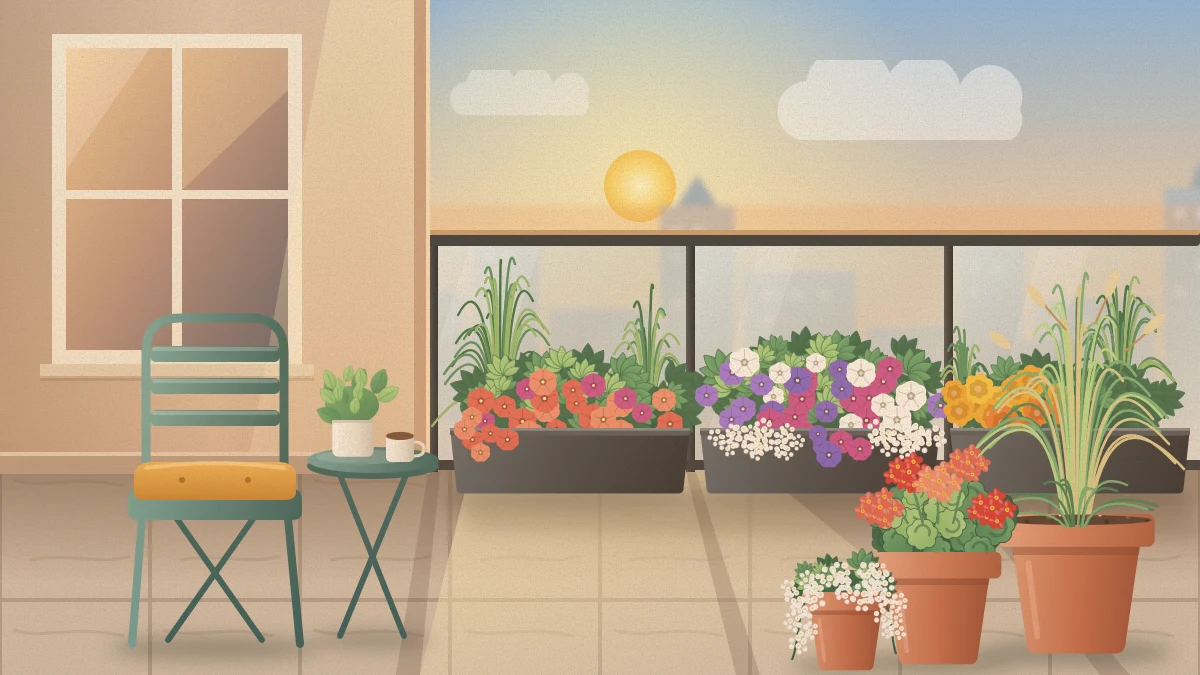
Set two or three troughs end to end on the floor along the railing side, and put your seat against the building wall facing them. The plants form a low hedge of flowers or grasses between you and the view, and the center of the floor stays open.
Long rectangular planters suit this because they follow the line of the balcony and waste no space between pots. Keep the planting below eye level where you sit, so you look over it rather than into it.
Suits: long, narrow balconies, and anyone who wants some screening from the street without losing light.
The corner cluster
Group three pots of stepped heights in one corner: a tall plant at the back, a medium, bushy one beside it, and a low or trailing one in front. Seen together they read as a single planting, and they take up one corner instead of scattering across the floor.
Odd-numbered groups tend to look more natural than pairs. Pots grouped closely also shelter one another from wind and shade each other’s sides.
Suits: square balconies, balconies with one sheltered corner, and beginners who want to start with three plants.
The herb strip by the door
The strip of floor beside the door, on the side the door does not swing toward, is often wasted. A short row of herb pots or one narrow trough fits there, and it puts herbs within arm’s reach of the kitchen.
Suits: cooks, and balconies where the far end is too windy for soft-leaved plants.
One statement container
Instead of eight small pots, try one generous container with a single bold plant or a small mixed planting. A large volume of potting mix dries more slowly than a collection of small ones, so there is one thing to check and water rather than eight.
Place it where it anchors the space, typically a corner on the floor, and choose a wide, low shape over a tall, narrow one. Advice on size, shape and material is in the guide to choosing balcony planters.
The trade-off is weight. A big planter full of wet mix weighs far more than it did empty, and it stays where you first put it.
Suits: people short on time, and balconies that already feel cluttered.
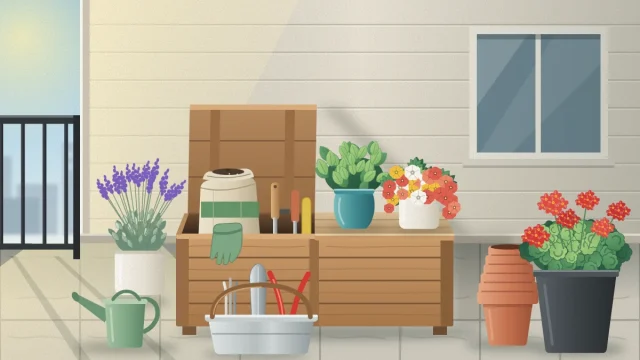
A narrow bench with pots above and below
A slim, stable bench against the wall gives you two levels from one footprint. Shade-tolerant plants or spare pots tuck underneath, a few small pots sit at one end on top, and the other end stays free as a seat or a place to set a cup.
Choose a bench with a slatted or water-resistant top, use saucers, and keep the larger pots on the floor level so the bench is never top-heavy. A lidded storage bench does the same job and hides tools and potting mix as well, which is covered in the guide to balcony garden organization.
Suits: balconies with no room for both a chair and a plant stand.
Principles that make a small space feel calm
The layouts above work for the same few reasons, and you can apply those to any arrangement.
- Repeat one thing. Pots in a single color or material make a small space feel orderly, even when the plants are all different.
- Vary the height. One tall plant, a few medium ones and something trailing give depth. All one height looks flat.
- Leave the view open. Sit in your chair before you place the tall plants. Put height at the sides and corners and keep the line of sight ahead of you clear.
- Choose fewer, larger containers. They dry out more slowly and are quicker to look after than many small ones.
- Use furniture that folds. A folding chair and a small folding table give the floor back when you are watering, repotting or sweeping.
Tip
Lay out empty pots, or sheets of newspaper cut to size, on the floor before you buy plants. Open the door, sit in the chair and walk the path. It is much easier to move paper than a planted trough.
Going up, carefully
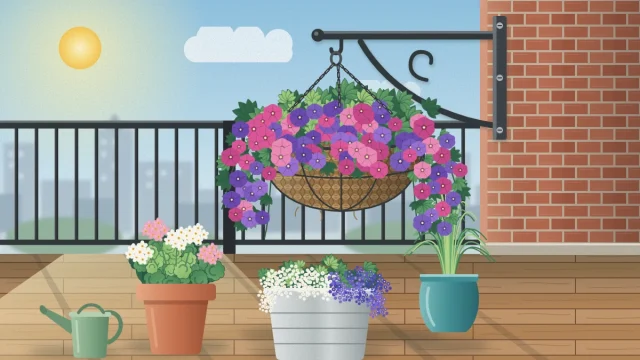
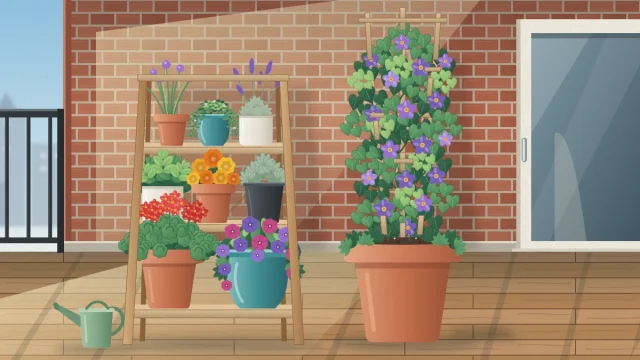
When the floor is full, height is the next place to look. A freestanding shelf or a trellis in its own pot adds planting space without attaching anything to the building. The guide to a vertical balcony garden starts with those options.
Good to know
For a large statement container, ask the building management or owner what the balcony is allowed to carry, and consider the weight of wet mix, water and the container together. For any idea that hangs or mounts, use secure mounting made for the purpose, check the building rules or your lease or ask the landlord before attaching anything, and follow the manufacturer instructions for the planter and its hardware.
The simplest arrangement is still the one every layout here is built on: containers on the floor, low, stable and inside the railing. Before a storm, bring in or secure anything light, including folding furniture and empty pots.
Two things undo any layout: blocking the exit, and covering every surface until there is nowhere to rest your eyes or your coffee. Start with one layout and live with it for a few weeks. You will soon see where you actually sit, which corner gets the light and whether there is honestly room for one more pot.
Frequently asked questions
How many plants fit on a small balcony?
Fewer than you expect, if you also want to sit there. Start with three to five containers arranged along one edge or in one corner, keep the door, path and drain clear, and add more only after a few weeks of using the space. Larger containers with several plants each are easier than many small pots.
How do I make a small balcony look less cluttered?
Repeat one pot color or material, group pots in a corner or a line instead of spreading them out, and swap several small pots for one or two larger ones. Leave some floor empty on purpose, and keep tall plants at the sides so the view from your seat stays open.
Where should I put the chair on a narrow balcony?
Usually against the building wall, facing the railing, with planters on the floor along the railing side. That keeps the middle of the floor open as a path, gives you the view over the plants, and puts the seat in the most sheltered part of the balcony.