
For the Record: A Roundup of the Best Turntables for DJs and Collectors
Vinyl Is Back — And the Right Turntable Makes All the Difference
A turntable is the heart of any serious vinyl listening setup — and in May 2026, it has never been more relevant.
Here are the best turntables to consider right now, whether you’re a dedicated collector or a first-time buyer:
| Turntable Category | Best For | Starting Price |
|---|---|---|
| Entry-Level Manual | Best budget pick | $249 |
| High-Fidelity Manual | Best under $1,000 | $999 |
| Fully Automatic | Best for beginners | ~$199 |
| Mid-Range Hi-Fi | Best mid-range value | ~$549 |
| Premium Direct-Drive | Best premium model | $1,000+ |
Vinyl records outsold CDs in 2022 for the first time in 35 years. That’s not a fluke — it’s a movement.
Listeners are tired of music playing in the background. They want to feel something. There’s a reason people talk about the ritual of vinyl — sliding the record out, dropping the needle, hearing those first soft crackles before the music begins. It’s intentional. It’s physical. It’s present.
And the sound? Analog audio captures the full soundwave without digital compression. No data is thrown away. What you hear is closer to what the artist actually recorded.
But with so many options — belt-drive, direct-drive, Bluetooth, built-in preamps, manual vs. automatic — it can feel overwhelming fast.
This guide cuts through the noise. We’ll help you find the right turntable for your home, your budget, and your ears.
The Evolution of the Turntable: From Phonograph to High-Fidelity

To understand the modern turntable, we have to look back at where it all began. The journey of recorded sound is a fascinating tale of mechanical ingenuity. It started in 1857 when Édouard-Léon Scott de Martinville invented the phonautograph. Interestingly, this device couldn’t actually play music back; it was designed only to visualize sound waves on paper.
It wasn’t until 1877 that Thomas Edison changed the world with the Phonograph . Edison’s machine used tinfoil cylinders to both record and reproduce sound. While revolutionary, these cylinders were fragile and difficult to mass-produce. Enter Emile Berliner, who invented the gramophone. Berliner’s genius was moving from cylinders to flat discs. This shift allowed for mass-stamping, meaning music could finally be distributed to the masses.
As the 20th century progressed, the technology refined into the formats we recognize today. We saw the rise of the “Long Play” (LP) record at 33 1/3 RPM, which allowed for full albums, and the 45 RPM “single.” By the time we reached the 2022 sales milestone where vinyl officially overtook CDs again, the turntable had evolved from a “talking machine” into a precision-engineered instrument capable of staggering audio fidelity.
Why the Turntable is Resurging in the Digital Age
In our May 2026 world, digital streaming is everywhere. So why are we flocking back to a technology from the 1800s? It comes down to “digital fatigue.” When music is just a file on a phone, it becomes background noise.
The turntable offers a “vinyl ritual” that demands your attention. You get to hold the album artwork, read the liner notes, and engage with the music as a physical object. There is also the matter of the “analog sound.” Because analog captures the entire soundwave, many listeners find it “warmer” and more “present” than the compressed files found on streaming platforms. It’s about intentionality—choosing to sit down and listen to an album from start to finish.
The Difference Between a Turntable and a Record Player
We often hear these terms used interchangeably, but there’s a key technical difference you should know before buying.
- Record Player: This is typically an all-in-one unit. It has the turntable, the amplifier, and the speakers all built into a single box (like the popular suitcase models). They are great for portability and convenience, but because the speakers are so close to the needle, vibrations can sometimes affect sound quality.
- Turntable: This is a high-fidelity component. It is designed to be part of a larger system. A standalone turntable usually requires an external amplifier and separate speakers. This setup allows for much higher audio fidelity and gives you the freedom to customize every part of your signal path.
Essential Components and How They Create the Analog Sound

A turntable might look simple, but it is a masterclass in vibration management. Every component plays a role in how the final music sounds:
- The Platter: This is the rotating disc where the record sits. Materials matter here. Budget models might use aluminum, but high-end decks often use acrylic or glass because they are denser, which helps dampen unwanted vibrations and maintain a consistent speed.
- The Tonearm: This is the arm that holds the needle. It needs to be light enough to move freely but stiff enough to resist resonance. Modern high-end tonearms use materials like magnesium because it is 33% lighter than aluminum and has ten times the damping capacity.
- The Cartridge and Stylus: The stylus (or needle) is the only part that actually touches the record. It’s usually made of industrial diamond. The cartridge is the “engine” that houses magnetic coils. As the stylus moves through the grooves, it creates a tiny electric signal.
- The Plinth: This is the base of the turntable. A heavy, high-mass MDF wood body is often preferred because it acts as an anchor, keeping the motor’s vibrations away from the sensitive needle.
How a Turntable Converts Grooves into Music
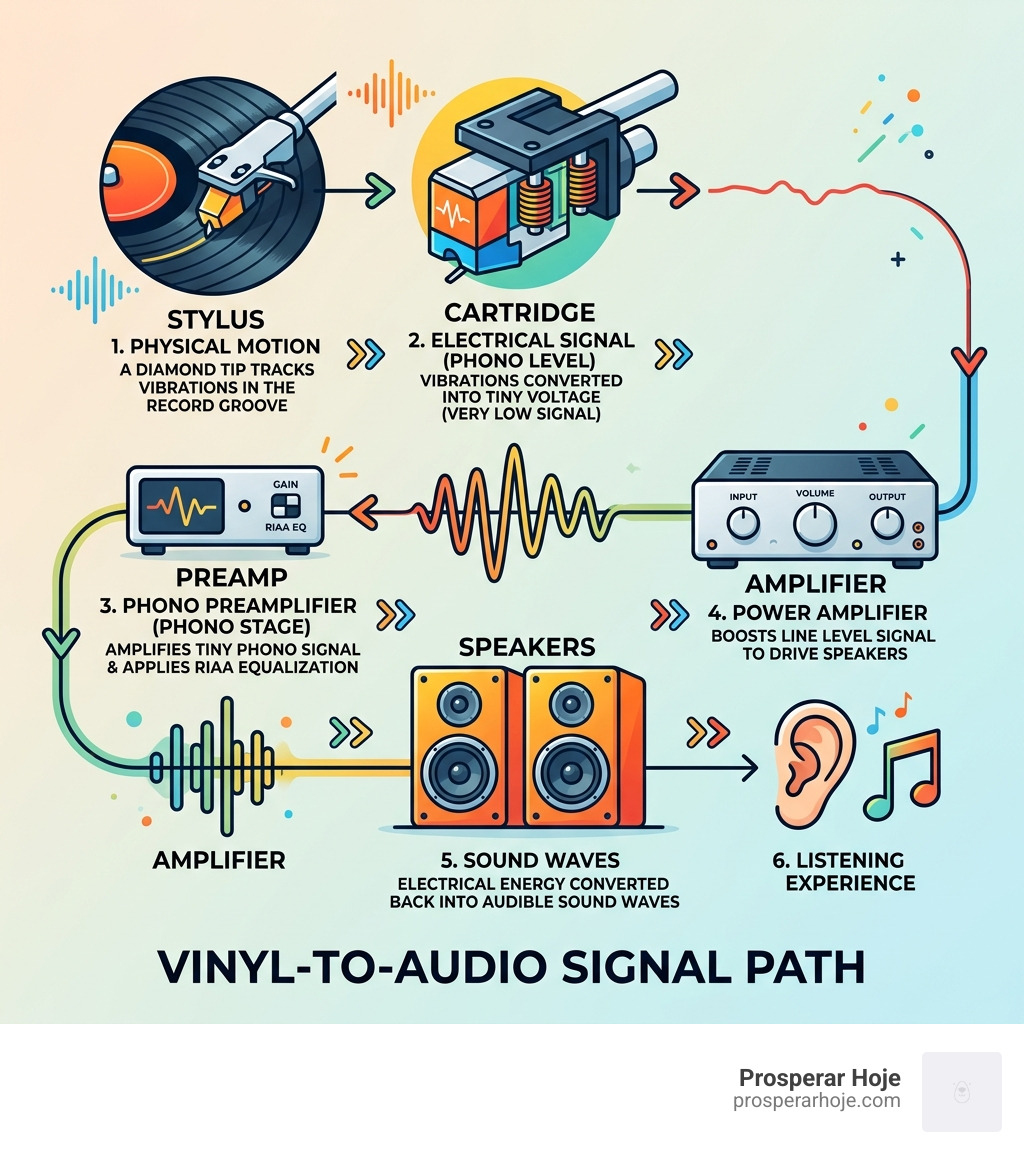
It feels like magic, but it’s actually physics. As the record spins, the physical grooves—which are microscopic jagged edges—cause the stylus to vibrate. Those vibrations travel up the tonearm into the cartridge.
Inside the cartridge, magnets and coils convert those physical movements into a very small electrical signal (the phono signal). This signal is too quiet for your speakers to play directly, so it must pass through a phono preamplifier to be boosted to “line level.” From there, it goes to your amplifier and finally out to your speakers as audible, glorious music.
Choosing Your Drive: Belt-Drive vs. Direct-Drive
One of the biggest decisions you’ll make is how the motor spins the platter.
| Feature | Belt-Drive | Direct-Drive |
|---|---|---|
| Motor Location | Off to the side, connected by a rubber belt | Directly under the platter |
| Vibration | Very low (belt absorbs motor noise) | Slightly higher (motor is attached to platter) |
| Torque | Lower (takes a moment to reach speed) | High (starts and stops instantly) |
| Best For | Audiophiles and home listeners | DJs and those who want “set it and forget it” speed |
Belt-drive systems are the gold standard for high-fidelity home listening. By using a rubber belt to spin the platter, the motor’s noise and vibration are physically isolated from the record.
Direct-drive systems are essential for DJs. Because the motor is directly connected to the spindle, the platter reaches the correct speed (33 or 45 RPM) almost instantly. This allows for “back-cueing” and scratching without damaging the motor. Modern high-end direct-drive units often use “coreless” motors to reduce a phenomenon called “cogging,” ensuring a perfectly smooth rotation.
Modern Connectivity and Automation Features
While the heart of a turntable is analog, the features in 2026 are decidedly modern.
- Bluetooth and WiFi: Many modern entry-level and mid-range models now include Bluetooth. This is perfect for those who want the vinyl experience but prefer the convenience of wireless headphones or speakers.
- USB Output: If you have rare records you want to preserve, a turntable with a USB output allows you to “rip” your vinyl into high-quality digital files on your computer.
- Automation Levels:
- Manual: You have to physically lift the arm and place it on the record, and lift it off when the side is done. This is preferred by audiophiles because it involves fewer mechanical parts that could cause vibration.
- Semi-Automatic: You start the record manually, but the turntable automatically lifts the arm and stops the motor when the record ends.
- Fully Automatic: Just press a button. The turntable does everything. This is the ultimate in convenience and prevents accidental needle drops.
What to Look for in Your First High-Fidelity Turntable
If you are just starting your journey, we recommend looking for a balance of quality and ease of use. A built-in phono preamp is a huge plus for beginners because it means you can plug your turntable directly into any powered speakers or a standard home theater receiver.
Look for a model with an upgradeable cartridge. You might start with a basic stylus, but as your ears get more “tuned,” you’ll want the ability to swap it out for something more detailed, such as a high-performance elliptical stylus. Finally, don’t overlook vibration isolation. Adjustable-height feet and damping materials like Sorbothane are “gold standards” for ensuring that a walking person in the room doesn’t make your record skip.
Frequently Asked Questions about Turntables
Do I need a phono preamplifier for my setup?
Yes, every turntable needs a preamp. However, many modern turntables have them built-in. If your turntable does not have one, or if you want to upgrade your sound quality later, you can buy an external phono preamp to sit between the deck and your speakers.
What is the difference between a conical and elliptical stylus?
A conical stylus is rounded like a ball. It’s durable and affordable, making it great for beginners. An elliptical stylus has a more elongated shape that fits deeper into the record groove. This allows it to track high frequencies more accurately, resulting in more “detail” and less distortion.
How do I maintain my vinyl records and stylus?
Keep your records clean! A simple carbon fiber brush can remove dust before every play. For the stylus, use a specialized stylus cleaner or a “gel bubble” to gently remove debris. The stylus is a consumable part—most need to be replaced every 500 to 1,000 hours of play to keep your records sounding their best.
Conclusion
At Prosperar Hoje, we believe that everyone deserves a remarkable listening experience. Whether you are hunting for rare funk reissues or just want to hear your favorite pop albums with that unmistakable analog warmth, the right turntable is your gateway to a deeper connection with music.
The technology has come a long way since Edison’s tinfoil cylinders, but the goal remains the same: simple home audio delivering big sound. By choosing a system that fits your lifestyle—whether it’s a budget-friendly automatic deck or a precision-engineered magnesium masterpiece—you aren’t just buying a gadget. You’re starting a ritual.
Ready to build your dream audio setup? More info about audio services can help you find the perfect match for your home. Happy listening!
